How to Write a Term Paper
How to Write a Term Paper
The keys to writing a research paper, or term paper as it is sometimes called, include:
1. Mastering research strategies: defining and refining interesting questions and developing and refining search strategies.
2. Applying reading strategies: note-taking, questioning, summarizing, paraphrasing, quoting, analyzing and critiquing.
3. Using the writing process to develop and narrow the question (topic), draft, and revise the paper.
The keys to good writing include:
- Proper grammar, spelling and punctuation.
- Precise and accurate vocabulary.
- Strong and active writing style.
You
might ask ‘why is it called a “paper”’? The answer might be because it is physically
written on a piece of paper. But then, what is “paper” really, and what is its
history? How does the history of paper relate to the history of writing, if at
all? Such questions can easily lead to an interesting topic for a research
paper about writing!
So, let's ask another question: What does “paper” mean? This leads to information
about different types of papers: research papers, actual papers, reports…etc. For
a middle school or high school student, writing a research paper might mean
focusing mostly on the topic, researching strategies, and reporting the
information. This type of paper might also be called a research report,
something often used in technical fields such as engineering and science. At
its best, this question draws conclusions about "what is known" on a
particular topic.
The more like a research report your own research paper is, the more important
it is to focus narrowly. Few people can read, let alone write about, everything
that is known about “paper”. However, a topic such as the rise of inexpensive
commercial paper and its use in education likely has a more manageable amount
of information available. Regardless of the topic, it will likely be necessary
to find some sources that are more general--paper and how it is made, for our
example--and some that are very specific--the influence of inexpensive commercial
paper production on the number of research papers assigned.
College research papers, which are often called term papers, usually require
more technical research from professional journals in the field and fewer books
than middle school or high school research papers. When writing a term paper,
the students are expected to demonstrate a level of understanding of the material
(facts, statistics, theories, controversies, etc.) within the field and methods
for researching, analyzing, and discussing that material. In addition, college
students are typically expected to ‘take sides” when discussing a debatable
question with which some people in the field might disagree.
College research papers and term papers are not just simple reports. Rather,
the student takes the role of a knowledgeable person in the field and uses the
research to provide supporting evidence and to develop thoughtful arguments.
The more advanced the course, the more advanced the arguments and research will
need to be.
College professors want papers that are free of errors. They want to read without
having to struggle to understand what they are reading. Make sure to proofread
your writing several times either manually or via an English writing tool.
For real help on writing a research paper, it might help to ask another basic
question: What is “research”? Why "re" rather than
"search"? “Research”, in the sense of writing a research paper, means
finding information. However, a common mistake students make is stopping there.
They don't go further to ask: what kind of information? Generally, it is not
information limited to points of view with which you agree. Good research
begins with uncertainty.
Often, for a report, the type of information is a broad question (or topic),
such as what is the life-cycle of the octopus? However, a great college
research paper will typically ask a focused question, such as: what is the
effect of increased levels of mercury on the life-cycle of the octopus along
New England Coasts? This question remains open, and the student writer
therefore will have to take a position on the topic that not everyone in the
field would agree with. Research answers a specific question, usually narrowly
defined. The researcher allows for the fact that the answer might be something
other than what first came to mind. This is the uncertainty necessary for good
research.
In order to find a research topic, one could continue with inquiries about the
word “write” (or “writing”). Writing involves a process. Within the general process,
research writing has its own steps that are typically followed. Remember,
though, as with many complex processes, often you will return to a step you
already did and either re-do it because of changes along the way, or do it
again from another point in the research. It is not really linear.
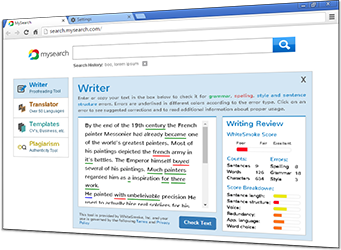
At whatever stage of your writing, WhiteSmoke can assist you. It works with any
program you are using, and can help you get just the right word at any point in
your writing. Use a thesaurus while taking notes or drafting. A dictionary will
also be of use throughout your research. And once you start drafting, you will
want to constantly check your grammar and spelling or to enhance your writing
with word suggestions.
Here are some steps to writing a research paper:
1. Find an interesting question to research. Don’t think that research is all about finding evidence for a position you’re taking. Rather, think about a question you can’t answer. The research will be more interesting this way, especially if the answer is of interest to you. How? Look through notes, readings, a few articles, and find where you're confused (and don't want to be), curious, frustrated, or where you otherwise stopped for a moment to think. What question does this moment of thought suggest to you? What would you like to know? Consider other areas of your life where you have passions--outside of school, other courses you've taken, politics, hobbies, etc. What questions do your other areas of interests suggest? Start doing this the moment you have the assignment--don't wait until the last moment, or you won't have time for the research or the writing.
2. Start reading. At first you’ll read background material to become familiar with the subject. If you were assigned a term paper at the beginning of the term, read ahead in some of the assigned readings, explore recommended readings, and go to the library to find books. In general, while using a search engine such as Google to find internet sites, Wikipedia and other encyclopedias may useful for background information, many teachers and most college professors do not accept these as research sources, unless the internet source you found is well-established as authoritative or provides a verifiable statistic. Use them sparingly, and only in order to get a general picture.
3. Read material more specifically related to your question. If you find too much material available, use this reading to narrow down your topic. On the other hand, if it is difficult to find any material on your topic, you may want to do some reading to open up your question a bit. It is important to start this process early on, both to refine your question and to locate and obtain relevant source material within the appointed time frame.
4. Take notes. Use a research journal, notecards, a PDA…etc. Any way that is comfortable for you – just keep notes. Make sure that you have a system so that your notes are organized and easily retrievable for future reference. One method is to assign each new source a number that refers to its note card (often called a bibliography card) or its line on a spreadsheet. Every note that relates to that source also gets the number on it. That way, you can find the source. All of the bibliographic material should be on the numbered card or spreadsheet line. Some software programs help you manage your sources and notes in a similar manner. It might be useful at this stage to determine which of the many citation styles will be required for the research paper, so the information on your cards or in your spreadsheet is formatted correctly to begin with. It is always useful to annotate your bibliographic cards (or spreadsheet, etc.) with a brief summary of the source and a couple of sentences that critique the source, noting its strengths, weaknesses, and relative usefulness to your topic. Summarize what you’re learning, what questions you still have and even keep track of your search strategies. Keep trying to answer your research question in your research journal while keeping in mind that you are “trying” and the attempts will likely change drastically the more you learn during the process.
5. When you feel that your research has suggested an answer to your question that is not changing dramatically anymore, write this down as a tentative thesis for your paper. Check with your teacher and get feedback on this tentative thesis. If you have to write a prospectus or proposal, this is usually a good point to do that. A research proposal provides the background and significance of the question. It often includes a tentative thesis, depending on the assignment. A prospectus is similar to a proposal in that it explains the question, why it is important, but it also usually includes what steps you will take to accomplish the research. A research prospectus may contain more background than a proposal. A research prospectus often requires an annotated bibliography of resources, something that is only sometimes required in a proposal.
6. After you’ve arrived at a tentative thesis, though still while researching (which might require you to modify or even change your thesis), begin going through your notes, annotations and writing journals. Start brainstorming ways to communicate what you've learned so that readers will understand why you think the tentative thesis is the answer. You could use an outline here, if you wish, or concept maps or free-writing or any number of strategies to help you start organizing your material for writing. Some people talk about it to a friend. Others simply start writing and see where it goes from there.
7. Write a draft of your paper. Don’t worry much about the introduction or conclusion yet. Just try to get all the necessary information on paper.
8. Keep reading and researching, even re-reading as needed, while still working on the draft. This can be a very rough draft that no one will see. After preparing the draft, it is time to start working on the outline of the draft. Review the outline, rearrange information, add/remove items…etc. Then re-write the draft using the outline as a guide (though not as a written-in-stone rule).
9. Create a working bibliography as you go. Anytime you use information from a note, add a source (from your system) to the bibliography (or works cited). Be sure to cite the sources as you use the information. All sorts of information from sources must be cited, not just quotes. This includes specific facts or data, claims or arguments unique to the source, dates, summaries, and paraphrases. A good guideline is that if you found the information in only one source, always cite it. If in 2-3 sources, usually cite it. More than that depends on the type of information or the context of the research--see a good writing handbook for more on citation. Always check with your instructor, editor, or publisher about the preferred guidelines for citation.
10. As you revise, continue your research. Now the research will take on a narrower focus – this is so that you can fill in the gaps, answer questions you still have about the topic or support evidence, etc.
11. Continue this process until you feel that the paper really says something that you have learned in the process, and that it communicates it well enough so that someone who has not done the research (or even thought of the question) would understand and be interested. At the same time, keep the interest of those who have thought of your question and even done the same research such as your college professor or fellow students.
12. Write the introduction and conclusion. Invite the reader to read about the topic by showing why it is interesting or important. Leave the reader satisfied by providing useful and thoughtful ideas.
13. Carefully re-read your draft. Once again, it is very important to check for any writing errors in grammar, spelling and even structure. Check your paragraphs using writing tools and software and make certain that your paper is an “easy read”.
14. Make sure that all the information from other sources is properly cited using the appropriate citation style. Remember that citation styles are an arbitrary system, so check the rules carefully with your professors and teachers.
Whether writing student research papers or scientific research, it is always important that you writing is correct. Always proofread and re-read the end result to make sure that you are conveying the message that you want to convey. After all, your writing is your image.