Use of the Hyphen in English Punctuation (-)
Don’t hesitate, hyphenate, but only when needed…
The hyphen (-) is a unique punctuation mark since it is used for both punctuation and spelling. In punctuation, it is used in certain word combinations, where its usage may depend on word order in the sentence. In spelling, it is used as an essential part of the word itself (see hyphen in spelling). The hyphen generally serves to link words or part of words together, signaling the relatedness between the linked parts. Using it may attract some disagreement among writers, as there are often different opinions on hyphen usage.
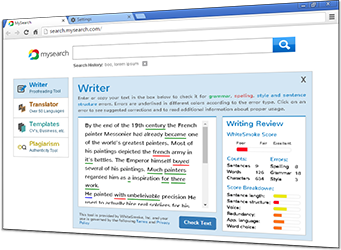
Be careful not to confuse the short, small hyphen (-) with the dashes (–, ―, —), which are at least twice as long and used for indicating interruptions and additions to a sentence. The WhiteSmoke English grammar software is your best writing tool, as it uses advanced punctuation- and spelling checkers that edit your text to perfection.
Hyphen Usages in Punctuation
1. Linking between words of compound adjectives
• Compound adjectives are a string of two or more adjectives or other words, which act like an adjective modifying a noun, or a compound noun. In some cases, it is clear which words modify and which ones are modified, while in other cases it is not. A hyphen is needed in such cases where ambiguity may arise.
Clear :
good civil servant
[ good modifies the compound noun civil servant, which is commonly used]
major league player
[ major league is a commonly used compound adjective that modifies the noun player]
nice old lady
[ nice and old are both adjectives modifying the noun lady]
Unclear:
good language rules
[Are the language rules good or are these rules for good language?]
exported wood products
[Are the wood products imported or are the products made of exported wood?]
dirty blonde hair
[is the blond hair dirty or is this a type of blonde hair shade?]
• Use a hyphen in cases of potential ambiguity or confusion with compound adjectives precede a noun. In addition, use hyphens with longer strings of words modifying a noun to make the reading easier
Five year-old babies were observed in the study
[Here there are five babies who are one year old]
Five-year-old babies were observed in the study.
[Here there are babies who are five years old]
No: Our company sponsored events are always lavishly organized.
[ sponsored may momentarily be perceived as a verb, meaning that the company sponsored something]
Yes: Our company-sponsored events are always lavishly organized.
[The hyphen makes it clear that company-sponsored is a compound adjective modifying the noun events, and that the verb is are]
Buy this all in one product in a one of a lifetime opportunity!
[ all in one and once in a lifetime are multi-word compound adjectives that may be confusing to read as distinct units of meaning]
Buy this all-in-one product in a one-of-a-lifetime opportunity!
[Using hyphens make these multi-word compound adjectives makes them easier to read]
• Do not usually use hyphens if the compound adjectives are commonly used phrases perceived as one unit.
A high school student, a major league player, carbon dioxide emissions
• Do not use a hyphen with compound nouns that appear after the noun. Do use a hyphen only when the compound is inherently spelled with hyphens, as shown in a reliable dictionary.
Prof. Higgins is a part-time lecturer who teaches under-graduate courses on up-to-date topics.
[compound adjectives are hyphenated if they appear before the nouns they modify]
Prof. Higgins teaches part time at the under graduate level on topics that are up to date.
[compound adjectives are NOT hyphenated if they appear after the nouns they modify]
Our all-in-one software is your best writing solution.
Our software is your best solution as it is all-in-one.
[the compound all-in-one is always hyphenated, before or after the noun it modifies]
• Do not use a hyphen when the first word of a compound adjective is an adverb ending with ly.
No: a beautifully-written poem, a freshly-chopped salad, a recently-released song
Yes: a beautifully written poem, a freshly chopped salad, a recently released song
• Do use a hyphen after an ly adverb if the compound includes at least two more words that are hyphenated.
The army general offered a brilliantly-thought-out plan.
Never rely on his hastily-written-down notes.
• Generally use a hyphen after adverbs not ending with ly, when the compound including them precedes the noun, or when the hyphen is an inherent part of the compound according to a reliable dictionary.
He presented a well-researched report.
Thousands attended the funeral of the much-loved teacher.
Beware of fast-talking salespeople.
• Use a hyphen with most comparative ( -er) and superlative ( -est) forms that are a part of a compound, but not when the words more, most, less, and least are used.
Yes: This is a better-fitting shoe, The higher-ranked participants went to the finals.
No: These are the least important issues today, The more promising students got a scholarship.
2. Indicating end-of-line word breaks
• Most writers today use a word processor that automatically aligns text so that no end-of-line-word-break is needed. Read this section if you are still using a typewriter or have to adhere to certain type-set requirements that make it impossible to avoid such breaks.
• We usually see end-of-line-word-breaks in printed books and newspapers, where a word is too long to fit on a line. Some amusing word-breaks have been noted in print media, such as the-rapist, men-swear, or mans-laughter. To avoid such embarrassing or other unclear word-breaks, follow the rules below.
• Break words only between syllables. Consult a dictionary that indicates syllable division within a word. As dictionaries of US and UK English differ on this point, be consistent in style.
No: ent-ertain, proc-eed
Yes: enter-tain, pro-ceed
• Do not break short words, one-syllable words, or words pronounced as one syllable, regardless of how long these are.
No: we-alth, school-ed, en-vy
Yes: wealth, schooled, envy
• Do not break a word if only one or two letters will be left on a line.
No: a-lone, funn-y, discov-er
Yes: alone, funny, dis-cover or disco-ver
• Break between two consonants according to pronunciation.
No: ful-lest, furnit-ure, referr-ing
Yes: full-est, furni-ture, refer-ring
Note: The following three rules are not compulsory but highly recommended.
• Break compound words at the hyphen, or between the words (in closed compounds).
No: by-prod-uct, com-monplace
Yes: by-product, common-place
• Break words that contain prefixes and/or suffixes, between these and the root word, not breaking any of the words' components themselves.
No: bro-therhood, superflu-ous
Yes: brother-hood, super-fluous
• Do not break a word if the two resulting parts are words themselves, but are unrelated.
No: bin-go, are-as, prose-cute
Yes: bingo, areas, prosecute
3. Avoiding word repetition
• If you use a word more than once in one sentence, each time with a different modifier, consider using a suspension hyphen. However, do not overuse the hyphen in this role. If the repeated word comes last in the compound, write the full compound at the end, and hyphens in the earlier combinations.
clumsy: He was referred to both clinic-based services and hospital-based services.
better: He was referred to both clinic- and hospital-based services.
clumsy: You can either choose a two-month program, a three-month program, or a four-month program.
better: You can either choose a two-, three, or four-month program.
• If the repeated word is the first part of the compound, write the full compound in the beginning and use hyphens for the next combinations.
The company-initiated and -sponsored events must be attended by all employees.
The Hyphen: Summing it up
This has been our review on the hyphen in punctuation. For better spelling, it is no less important that you read our review about the hyphen’s roles in spelling. These include:
• Linking between words of compound nouns and verbs
• Linking a prefix or suffix to a word
• Linking words that represent numbers
As we cannot always tell whether we are using punctuation marks correctly, the WhiteSmoke writing software will always help you decide on problem punctuation issues.
Copyright © 2002 - 2008 WhiteSmoke Inc. All Rights Reserved


RSS