How to Write a Paragraph
Paragraph writing remains one of the most important parts of writing. The paragraph serves as a container for each of the ideas of an essay or other piece of writing. Paragraphs are versatile and can take many forms that strengthen your writing, provide variety for readers, and help readers to organize the ideas you present.
Paragraph Length in a Piece of Writing
While it is true that a paragraph may be of any length, it is most common for an essay paragraph to be at least 3-5 sentences long and to be no longer than half a typed, double-spaced page. Journalism paragraphs (newspapers and magazines) tend to be 1-3 sentences long. Some paragraphs in books, especially technical treatises, might go on for several printed pages.
No matter what length an individual paragraph, most good writing varies paragraph length within any one piece of writing. If there are a few short paragraphs, then a longer one usually comes along. If there are one or two long paragraphs, usually a short paragraph or two will intervene to give the reader a short break in concentration.
Use Paragraphs to Break Up Ideas
A paragraph is the container for only one idea. Often, a longer paragraph can - and should - be divided into smaller units. Usually a large, complex idea is made up of smaller ideas and can be explained in more paragraphs with those smaller ideas. The point, though, is to have one coherent paragraph - all of the ideas in each sentence of the paragraph must relate to a single main point. That point is most often made in a topic sentence.
Topic Sentences in Paragraphs
A topic sentence gives the main idea of a paragraph. It usually occurs as the first or last sentence of the paragraph. Some paragraphs will not have a topic sentence, if the main point is obvious. Others might place the topic sentence slightly differently. Occasionally, as in this paragraph, the topic sentence might begin the paragraph but be restated in a different way at the end. That is to say, most writers put the topic sentence of a paragraph at the beginning or the end or both.
Grammar in Paragraphs
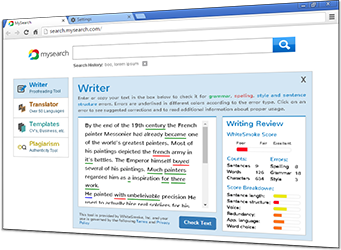
Every sentence in a paragraph must be grammatically correct, in so much as that grammar aids in understanding the ideas that the writer would like to convey. The topic sentence, in particular, must be very well written and very clear to readers. Of course, WhiteSmoke's grammar checker can be employed here to pick up any errors. The WhiteSmoke free online grammar checker could even be used if you just need to check your writing very occasionally.
Types of Paragraphs
Most writing has an introductory paragraph or an introduction of a few paragraphs, and a conclusion of a few paragraphs or concluding paragraph. The introduction and conclusion are, of course, supported by body paragraphs. The typical body paragraph develops, supports, or elaborates a given topic sentence. Most paragraph structures longer than 1-2 sentences have common elements.
For example, expository paragraphs have three important elements common to most paragraphs: flow, or unity (a clear connection to the rest of the essay and placed in a sensible way among the other paragraphs; development (detailed, specific support or elaboration of the main idea); and coherence (each sentence clearly relates to the previous and next sentence in an understandable and sensible manner). Persuasive paragraphs focus on developing a strong argument that would convince someone who disagrees with the writer's position.
Narrative paragraphs have similar features of flow (or unity) and coherence. However, the development might be more related to the action or events narrated in the paragraph than to supporting an argument. Coherence in a narrative paragraph usually comes from the chronological order of the "story" or narrative. Similarly, a descriptive paragraph might find its development through giving a series of sensory details or of abstract ideas that describe an object (or concept or theory), rather than through support. These two types of paragraph - narrative and descriptive - differ only slightly in these respects from expository paragraphs, but the differences are still important.
With some attention to flow, development, and coherence in your paragraphs, you will soon be writing powerfully.